August Part 1

I realized that I have been really bad the past two months about updating my blog. I’ve been pretty busy lately, which I think is a good thing. Makes time go by faster.

I’ll start with August. August went by really fast and I only spent just over a week in my village. The first two weeks I was down in Lusaka with all the other 2017 RAP volunteer for In Service Training (IST). It was so nice to see everyone again! It was great to see our technical trainers as well. Because travel is so difficult here, some people had to travel multiple days to get from their site to Lusaka. It took one guy who is placed in North Western three days to get from his site to Lusaka. Zambia is roughly the size of Texas, so slow travel time is more to do with the lack of infrastructure than country size.

The first week of IST was more technical training. We talked over any problems we we’re having at site. Some people had some interesting stories about their site. Some about kidnaps and others all the animals in the village being rounded up and shot (no volunteers were hurt/threatened in these stories. Or where they ….. dun dun dunnn)

During the fist week we also got a crash course in gardening and got to visit this really cool organic farm. LIFE, the other (agriculture/forestry) program we came into country with is all about promoting conservation farming. I think this is a very important program and Zambians should be encouraged to practice organic farming. I feel this way not because I’m a hippy greenie but because fertilizer is very expensive and cuts way into local farmers profits. Farmers already don’t have the best yields and majority of village farms are living in poverty. Also, because locals are not educated on farming practices, so some of what they are doing is harmful to their environment. So the LIFE program teaches organic farming practices that increase yields, are low or no cost and help with conservation.

The second week of IST was focused on HIV training. Mostly volunteers and the counterpart we brought got trained on a program called Grass Roots Soccer (GRS). GRS is an international program that focuses on teaching young adults about HIV, how to protect yourself from HIV, and tries to reduce stigmas around HIV/AIDS. GRS receives some of its funding through the US government and often pairs with Peace Corps throughout the world, but it is a totally separate program than Peace Corps. GRS has a specific curriculum that we are supposed to follow that is engaging to youth and is also pretty fun. During the training we went through 4 of the sessions, just like we were the youth. We got to act like kids, give each other exaggerated high-fives, and dribble a soccer ball (I got to showoff how un-athletic I am, knocked over way too many cones).

During the HIV training we learned about the different challenges the HIV/AIDS crisis has in Zambia. One of the problems is that ARVs (the HIV suppressant drug) can be hard to come by in the village. ARVs need to be taken at the same time everyday to be effective. So if you don’t have regular access to the ARVs, this causes an issue. Some villagers don’t even have watches or clocks, they use the sun to help them tell time. My host father often does this. He’ll look up at the sun and be like “it’s 11:43” he’s always very specific on the time, no idea why, but he has yet to be correct.

ARVs also decreases the chance of an infected person spreading it to another person. For example breastmilk is one of the ways HIV can be transmitted, if a mother is taking her ARVs consistently then there is a reduced chance of spreading it to her child. Unfortunately clinics don’t always have the ARVs available. These drugs are very expensive but are subsidized by the Zambian government. The drug expense and how difficult it is to travel around the country all play a role in the lack of ARVs. Not to mention that many people are a hours walk away from the nearest clinic. Plus sometimes testing and ARV distribution are done in specific days. This might discourage people to go to the clinic those days because they don’t want people to know they are HIV positive (there is a huge stigma around it). There are so many different layers to this problem it can become a little overwhelming.

Once again, I’d like to leave you on a very depressing note. I promise I’m enjoying myself and am not just crying in my hut all day long.
IST is Coming

I am finished with Community Entry and am about to head down to Lusaka for In Service Training (IST). I am so excited to be in Lusaka soon! There I will be reconnected with all the people I went through training with. After being separate for three months we are all planning on getting drinks and some good food.

Words do not explained to how happy I am to be eating non-village food soon. I literally have been dreaming about food, waking up every morning drooling (okay, I might normally do the drooling part). Last week I was reading a book based in Vegas and I had to stop reading it because it kept in talking about all the food and I just couldn’t handle it. I will say I’m not as in bad shape as some of my other Peace Corps friends. Another volunteer said she started crying when in a book she was reading the main character used an electric tea kettle. I’ve heard from multiple people who are so sick of having to start a fire for every meal they have resorted to just eating their food dry, like dry soya pieces. In the village there basically is no such thing as snack food or a quick meal. So Lusaka will be a needed break.

IST will be a total of two weeks. The first week we will be going over how our sites have been and program management. The second week will be more HIV training, and will be learning techniques on how to teach prevention. Because Peace Corps is all about sustainability we will bring a counterpart from the village to both the program management and the HIV training. That way, even after we leave Zambia someone in the village will be trained on these issues.

I believe I have setup a good foundation for my project in the community. The school committee and the community have been working tirelessly on building bricks to rebuild the school and a house for a teacher (communities are required to provide a government teacher with a house). The work we have done has slowly been paying off. The government said they were impressed with what has been done and announced the school as an primary school (this means it is officially a government school and not a community school). This opens the door to help get government funding and is the first step in getting a certified teacher in the school. I am hoping when I’m in Lusaka I can get more information about the learning standards for each grade so I can help make lesson plans with the community teacher. These standards have been very difficult for me to find, but will have a huge impact. I’m hoping by the beginning of next year, when the new Zambian school year starts, the government will place a certified teacher in the school.

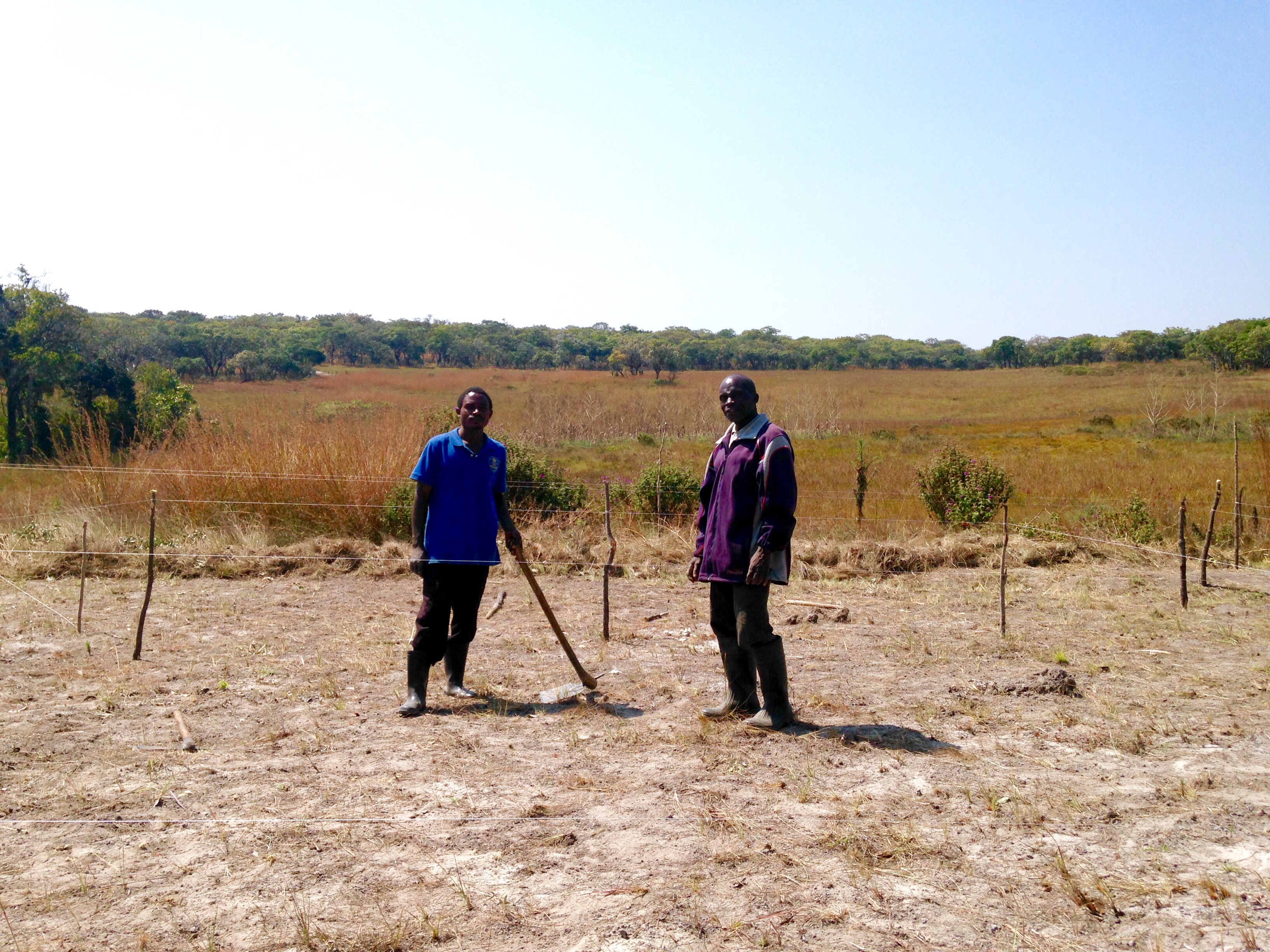
Fish farming has been been a little bit slower. It is no surprise, I expected this. I did give a fish farming lesson in Bemba, which is painful and about the extent I have used Bemba in the village. So far I’ve helped farmers with site selection for new fish ponds, gave tips on how to improve the structure of existing ponds, and staked a fish pond and set up dates to do more staking (just call me Buffy the fish slayer). My main focus now is to try and find fingerlings (baby fish) for the farmers so they can stock their ponds during the start of the hot season in September.

The bee keeping has been another project I focused on. The last volunteer trained 100 people in the community on bee keeping, how to make bee hives and how to make wax products. He also found a company that would bring ten bee hives for every person and also buy the honey the hives produced (basically contract honey farming). Unfortunately this company pulled out of the deal. Which is really disappointing for the people in the community because it would have helped them immensely with financial security. However the bee keeping group has slowly been making and selling bee hives to people in other communities, so the group has been brining in a little income (not nearly at the same level). Now we are focusing on trying to make our own hives. The problem is not everyone can afford buying planks for the hives. Now, we are planning on try to and cut down our own trees to make our own wood planks for the hives. As you can imagine doing all this by hand is a ton of work. We’ve also been working on creating a business plan that fits the new direction of the bee keeping group. Hopefully we can get the bee hives made before swarming season, but this will be a difficult task.

One of my favorite things I’ve done during Community Entry is partake in the Under 5 weigh in. Once a month the the children under five get weighed, chart their growth and are given vacations (if needed). There is no clinic in my community and this is the only event where the clinic workers from the nearest clinic (1.5 hours walk away) come to the community. It is a packed event and the mothers usually get all dressed up to weigh in their kids. It’s is really funny to watch the little ones get weighed. They tie a hanging scale to a tree branch, then hook up sling that looks one of those swings for babies. About half of the kids cry when they are stuffed in the sling, and the other half just chill swinging under a tree branch while they get weighed. The babies really start crying when they see me the “musungu” (basically Zambians version of gringo). I seriously have never had so many babies cry at me than I have in Zambia. I guess stranger danger kicks in real hard when you see the musungu. One of my host sisters kids cannot even look at me with out crying, even if she sees me from a crossed the compound she starts running away crying.

During Community Entry I have learned a lot. For example, someone telling you “I live near by” it can be anywhere between a twenty minute walk to a two hour walk over a freaking Zambian mountain. Also, I guess my biking has gotten better because my host father stopped asking me if I “learned to bike in Zambia”. However my bike maintenance has not improved, while cleaning my breaks recently I somehow completely disabled my front brake, so now I only have the back ones working. But hey, brakes are for crying babies!

Random Notes

When I was living/traveling in Ecuador I felt it a little bit, but I definitely feel it here in Zambia. The automatic connection to someone because they are an American. I don’t think it is due to speaking the same language (even though it probably plays a part) there are plenty of people who speak English in my village. I think it’s because of a shared culture. People I probably wouldn’t be friends with back in the States I have found myself becoming friends with them when I travel.

The conversation is more at ease when you are speaking with someone who you share the same cultural upbringing. You don’t have to worry about doing the proper greetings, they understand your bad jokes, they eat similar foods to you and wear the same style of cloths.

I have a better understanding why immigrant and refugee communities back home often stick together. It’s not about wanting to change the country that you are in. It’s that when you’re living in a different way than you’re used to, constantly sounded by that difference and trying to respect it, understand it, and fit in. It’s nice sometimes to be with people from the same culture, where you don’t always have to be trying. Zambian women, especially in the village, really wear pants and don’t wear dresses above their knees. It gets a little old feeling restricted by your clothing choices.

This is one of the reason why have a Peace Corps Provincial house (prov house) is so nice. When I’m at the prov house I’m real risqué and don’t wear leggings under my dresses the hits two inches ABOVE the knee (the whole room gasps). After I change into my fleewsy outfits I usually just chill with other volunteers. Never in the States while eating dinner, or watching tv, have I ever thought “I’m so glade to be sharing this culture right now” but that does cross my mind when at the prov house.

Every volunteer is allowed to spend 4 days a month at the prov house (volunteers are supposed to be working 24/7 we don’t get the weekends off to go places). We can use this time to do work on the house computers, do research online or in the little library, and/or just hangout. I was told that most other Peace Corps countries don’t have prov houses. Zambia gets them because it has one of the largest amount of volunteers and it’s volunteers live the most rural.

During the three months of Community Entry you don’t receive the 4 prov house days. However, my intake was lucky enough to be able to go to the house twice. Once for immigration (there was a mess up on our visas, this usually doesn’t happen) and another for what we call Provs. Provs is a semiannual meeting each provincial house holds in June and November.

Every volunteer in the Province makes the great migration to the house, and a staff person from Lusaka, for two days of meeting. On the last night there is always a themed party. Being in Central Province our theme this Provs naturally was Central Intelligence. We had a spy themed party where everyone dressed up and played a murder mystery game set in the Cold War Era. Everyone had a blast acting out their characters trying to find who the killer is while also complete the secret task we were given. I got too distracted (I know shocking) trying to sell missile plans to the Russians to figure out who the killer was. I know what you’re thinking, there is no way in 2017 that someone from the US government (technically volunteers are) would be colluding with Russia. Having Provs was such a nice break from the village life.

I think the shared culture thing in a different country is one reason why volunteer make fast friends. Even though I really enjoy all the volunteers I’ve meet in Central, it is kinda sad to be away from the people in my intake. The RAP people I came in with are spread out a crossed 5 of Zambias provinces, and Central received the least. Our intake became pretty close and is one of the only to make it through Pre-Service Training without having anyone ET (early terminate/leave). Unfortunately during Community Entry we have had our first person ET.

I would never judge someone for ETing. Things can be very difficult in the Peace Corps. You’re away from friends and family and all the comforts of home. You’re alone in a village in a different culture. You don’t have running water or electricity and everything takes forever to do with out it.

Even with awesome supportive friends and family back home and a great host family it can be hard. I have had times where I have cried. Actually, I just had one the other day. I was trying to get my fire started to warm my water for my morning jungle oats (oatmeal) and coffee and the fire just wouldn’t start. I put more kindle in, fanned it, lit it again and again and nothing happened. I was so annoyed I stomped inside and made myself some cold jungle oats. Then I sat down and cried while eating them. I looked totally ridiculous being a grown woman crying into her jungle oat (my tears didn’t even warm the oats up, total BS). At this point I’m totally used to sucking at starting a fire, for whatever reason that day it got to me. I don’t even have room to complain, my family gets all my firewood and water, but still …(pause for dramatic effect) …. I cried.

Well, I’ve always heard it’s best to leave things nice and depressing. So I’ll end my post here, now go cry into some food!